

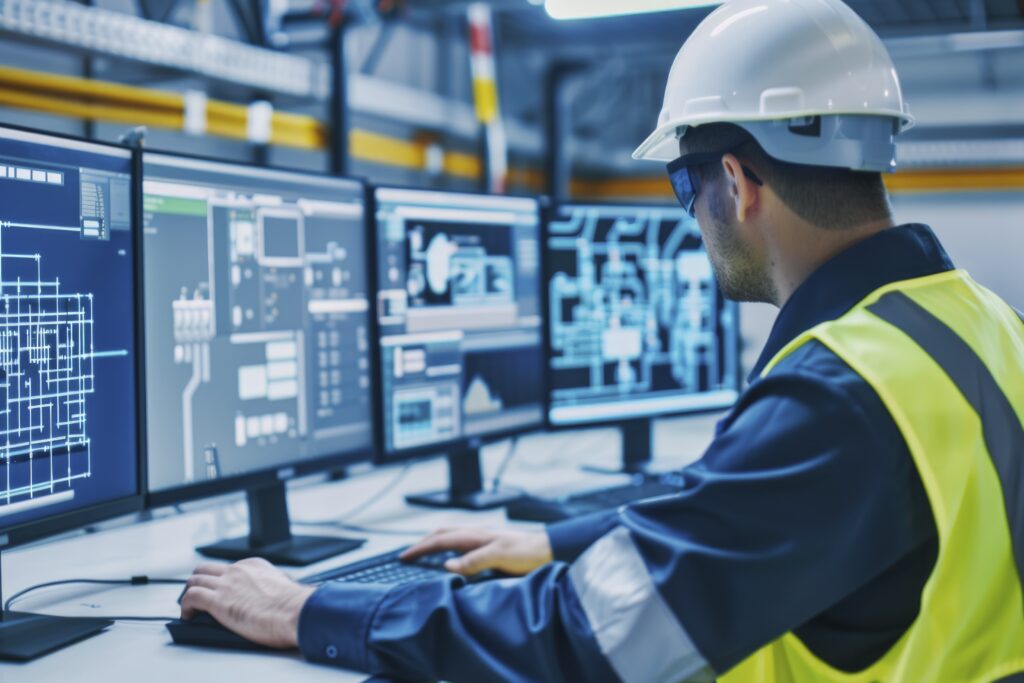
Industrial network security has become the most critical pillar for ensuring business continuity in the connected era.
This is because Industry 4.0 has brought with it incredible promises: maximized operational efficiency, AI-based predictive maintenance, IoT sensors monitoring processes in real time, and fully integrated supply chains.
However, this hyperconnectivity has come at a high price. The former physical isolation of the factory floor—known as an “air gap”—has disappeared. By connecting Industrial Control Systems (ICS) and Operational Technology (OT) networks to the internet and corporate Information Technology (IT) systems, industries have opened the door to severe vulnerabilities.
In this complex landscape, traditional cybersecurity strategies are no longer sufficient. We must go beyond perimeter defense. This is where Resilience Engineering comes in.
In this full article, we’ll explore how this concept is redefining industrial network security and how your company can apply it to ensure business continuity.
What is Resilience Engineering in industrial network security?
Historically, cybersecurity has focused almost exclusively on prevention: building more robust firewalls, implementing antivirus software, and creating barriers to keep attackers out.
In the industrial environment, however, the “guess and block” mindset falls short when faced with modern, persistent threats, such as targeted ransomware and zero-day attacks.
Resilience Engineering shifts the focus of the question.
Instead of asking, “How can we prevent 100% of attacks?”, she assumes that a security incident will eventually happen. The right question then becomes:
“How can our network absorb the impact of an attack, continue to operate, and recover quickly?”
Cyber resilience, therefore, is the ability of an industrial system to anticipate, withstand, recover from, and adapt to adverse conditions, attacks, or internal failures, ensuring that critical processes (such as the production line or power supply) never come to a complete halt.
Why Does Industrial Network Security Require Resilience Engineering?
To answer this question, we must examine the cultural and technical clash between (corporate) IT and (shop-floor) OT.
The security objectives of both worlds follow the classic C-I-A triad (Confidentiality, Integrity, and Availability), but with completely reversed priorities.
Understand the security priorities between IT and OT:
| Prioridade | IT Environment (Corporate) | OT Environment (Industrial/Shop Floor) |
| 1ª Priority | Confidentiality: Protecting strategic data and customer information from leaks. | Availability: Production cannot stop. Seconds of downtime cost millions. |
| 2ª Priority | Integrity: Ensure that stored data is not improperly altered. | Integrity/Safety: Prevent failures that cause physical accidents or environmental damage. |
| 3ª Priority | Availability: If a system goes down, it can be restarted over the weekend. | Confidentiality: Protecting recipes or industrial formulas (critical, but secondary to human life). |
Applying traditional IT tools to OT without due care can be disastrous. A simple, active, and aggressive vulnerability scan—which is common in IT—can overload a legacy Programmable Logic Controller (PLC), bringing an entire assembly line to a standstill.
The 4 Pillars of a Resilient Industrial Network Architecture
To build an infrastructure capable of securely supporting Industry 4.0, resilience engineering relies on four fundamental system capabilities:
1. Forecasting (Asset Visibility)
You can’t protect what you can’t see. The first step toward resilience is the passive and continuous mapping of all plant assets (PLCs, HMIs, frequency inverters, sensors).
It is necessary to understand the normal behavior of network traffic in order to identify anomalies (such as an OT device attempting to communicate with an unknown external IP address) before the attack spreads.
2. Absorption (Segmentation and Zoning)
The ability to absorb an impact is directly linked to the network architecture. If an operator infects an office computer by opening an email containing malware, that attack cannot spread to the process control network. Segmentation prevents the attacker from engaging in so-called “lateral movement.”
3. Efficient Recovery
In the event of an incident, the system must resume normal operation as quickly as possible. This involves thoroughly tested incident response plans, up-to-date offline backups of firmware and network configurations, as well as physical redundancy for links and industrial switches.
4. Adaptation (Continuous Evolution)
Resilience is dynamic. After any incident (whether an actual incident or a near-miss), the lessons learned should be used to modify security policies, update firewall rules, and train engineering and IT teams.
Best Practices and Essential Standards for Industrial Network Security: The IEC 62443 Standard
When it comes to global standardization for industrial network security, the IEC 62443 standard is the backbone. It provides a detailed framework for mitigating vulnerabilities in industrial automation and control systems (IACS).
One of the standard’s key recommendations is the concept of Zones and Conduits:
- Zones: Logical or physical groups of assets that share the same security requirements (e.g., Controller Zone, Supervisory Zone).
- Conduits: The communication paths that connect these zones. All traffic passing through a conduit must be strictly monitored, inspected, and controlled by industrial firewalls.
Implementing the Industrial Zero Trust Model
Zero Trust-based architecture (“Never trust, always verify”), as adapted for TO, stipulates that no device or user, whether inside or outside the factory network, should have automatic access to control systems. Each connection must be authenticated, authorized, and encrypted on a granular basis.
How Tracenet Is Transforming Industrial Network Security
Accelerating the transition to Industry 4.0 without a native cybersecurity strategy puts the future of the business at risk.
Tracenet has a deep understanding of the complexity of IT/OT convergence and offers tailored solutions to build truly resilient networks:
- TO Vulnerability Assessment: Passive, non-intrusive evaluation of the manufacturing environment to identify configuration flaws and vulnerabilities without risking operational downtime.
- Network Prototyping in Accordance with IEC 62443: Design and implementation of robust network segmentation using secure zones and conduits.
- Real-Time Threat Monitoring and Detection: Deep visibility solutions specialized in industrial protocols (such as Modbus, Profinet, DNP3, and EtherNet/IP).
- Incident Response Plans: Structuring agile processes to ensure that, should an anomaly occur, your plant knows exactly how to respond and recover in minutes, not days.
O quão preparada está a infraestrutura de rede da sua fábrica para resistir ao próximo desafio cibernético?
Na era da Indústria 4.0, a segurança cibernética não deve ser vista como um centro de custo ou um obstáculo para a inovação, mas sim como um habilitador de negócios.
Uma indústria resiliente protege suas margens de lucro, resguarda a segurança física de seus colaboradores e garante a confiança de seus clientes e parceiros de mercado.
Não espere pelo primeiro sinal de parada na produção. Fale hoje mesmo com um dos especialistas em segurança de TO da Tracenet e descubra como podemos desenhar uma estratégia de resiliência sob medida para a sua operação.